
Electro-Magnetic Field Improves Lixiviant Uptake in Gold Ore.
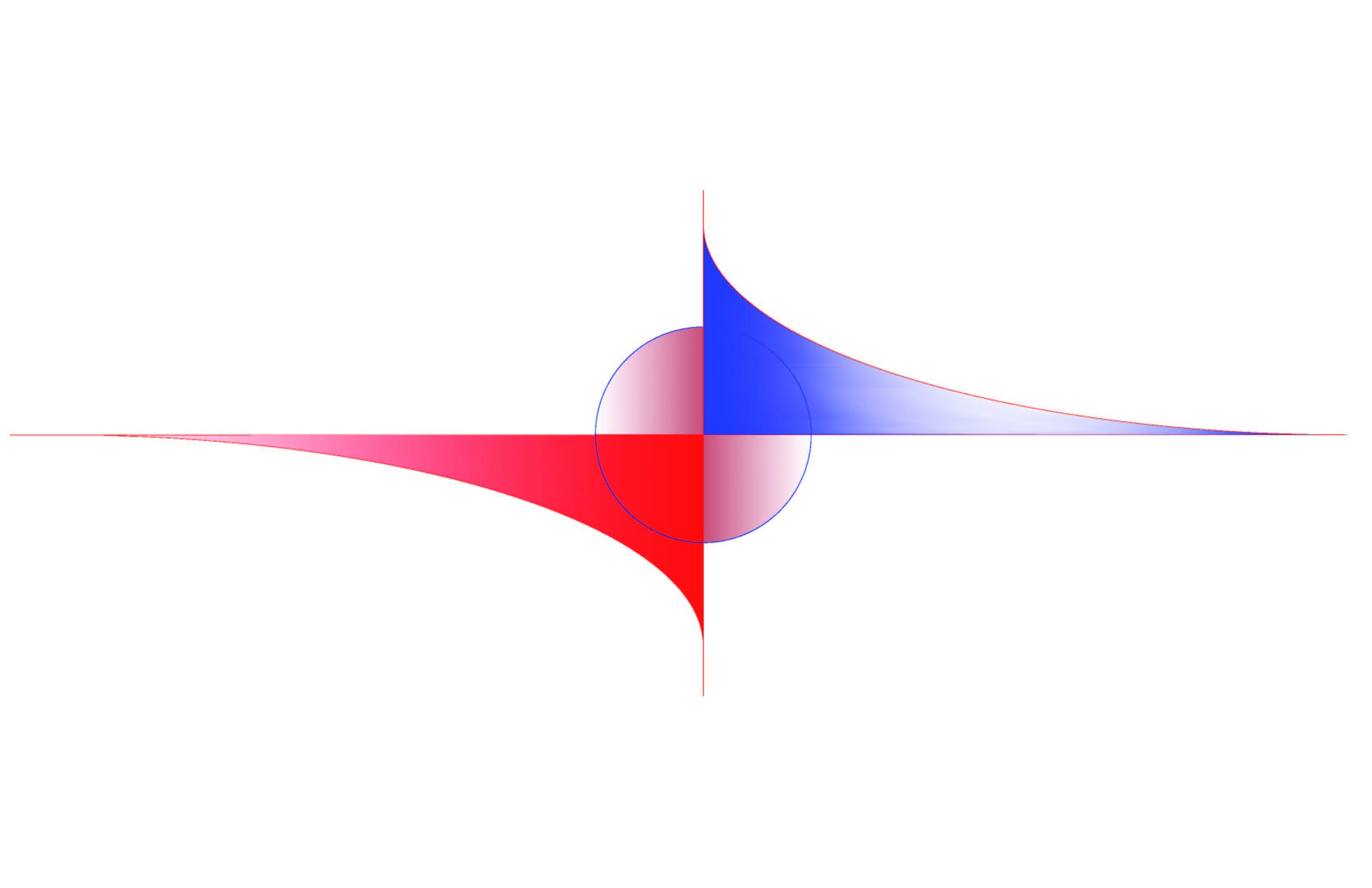
An Electro-Magnetic method of generating microscopic fissures and fractures into the silica morphologies of gold ores has been confirmed and validated at Barrick Gold’s Technology Center. Gold and silver nanoparticle clusters with other ferro-magnetic metals in the silica ore matrix generates strain in the proximal surounding silica when exposed to an electro-magnetic field for a significant increase of lixiviant uptake thus increasing gold and silver recovery with Merrill Crowe heap leaching. We have significantly improved the aqueous porosity of gold ore and show that the technology is economically viable no matter what lixiviant is used.
Inventors; Ed Melcarek, Steve Duncombe and Dr. Michael Albarelli scientist
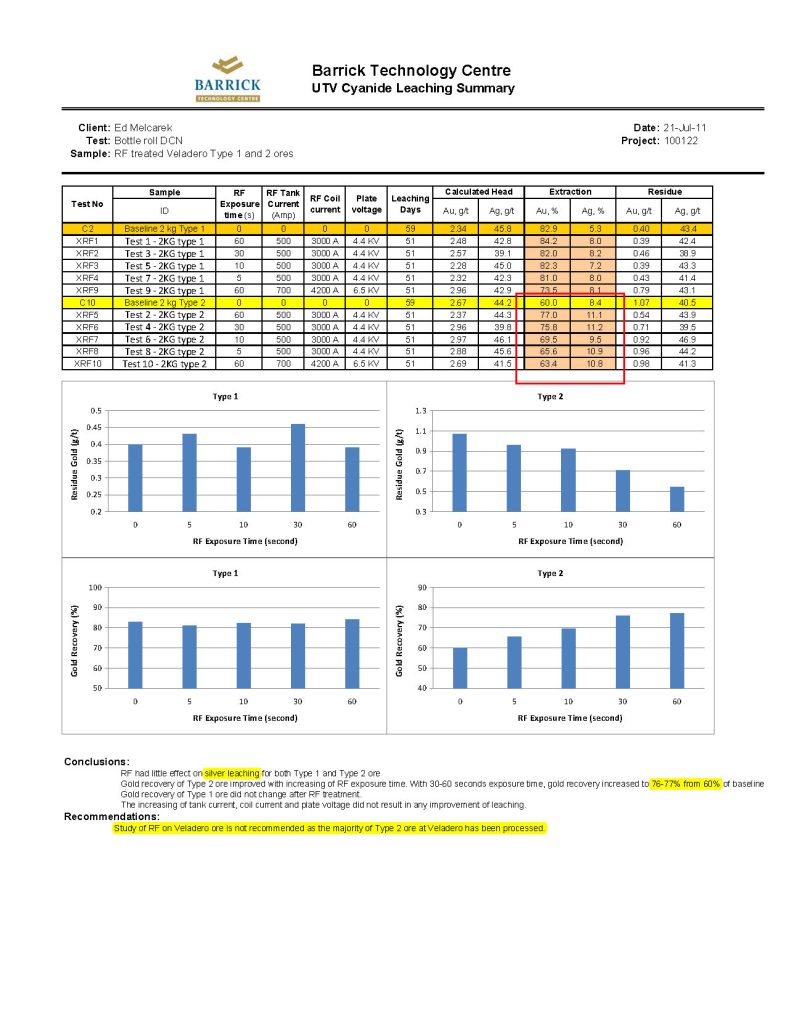
Barrick Gold assay results shows a 10 to 17% gold recovery improvement over baseline after cyanidation in a 3 day cyanide bottle roll assay done in 2009 – 2010 in Vancouver BC.
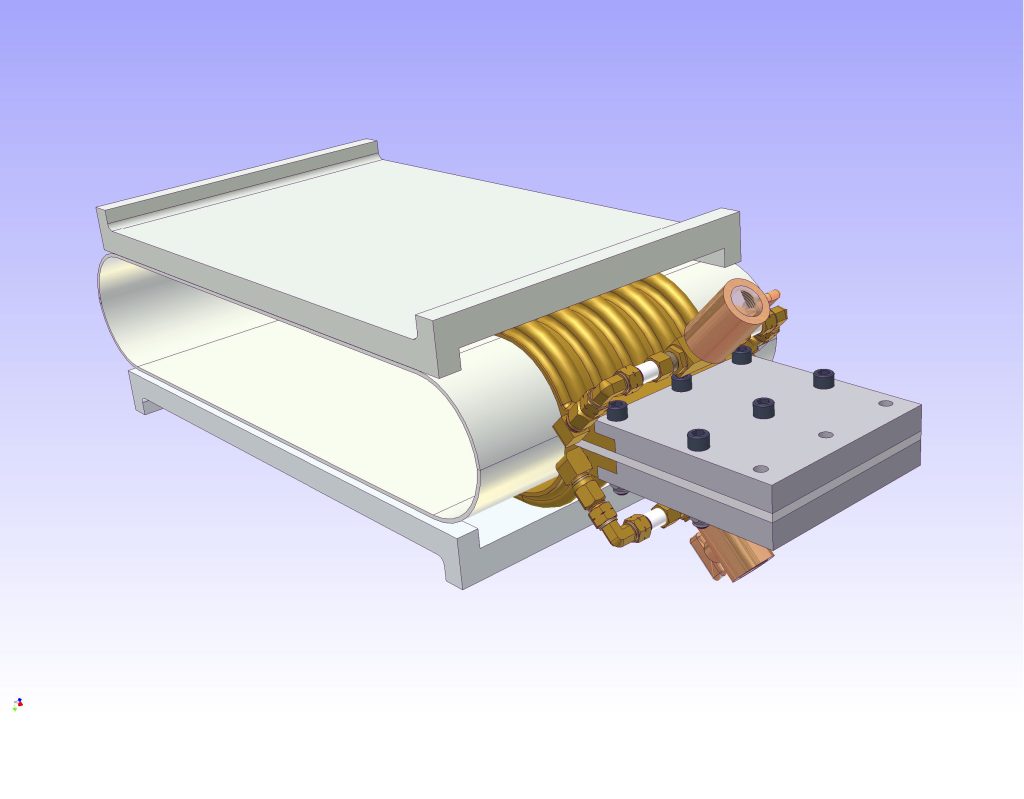
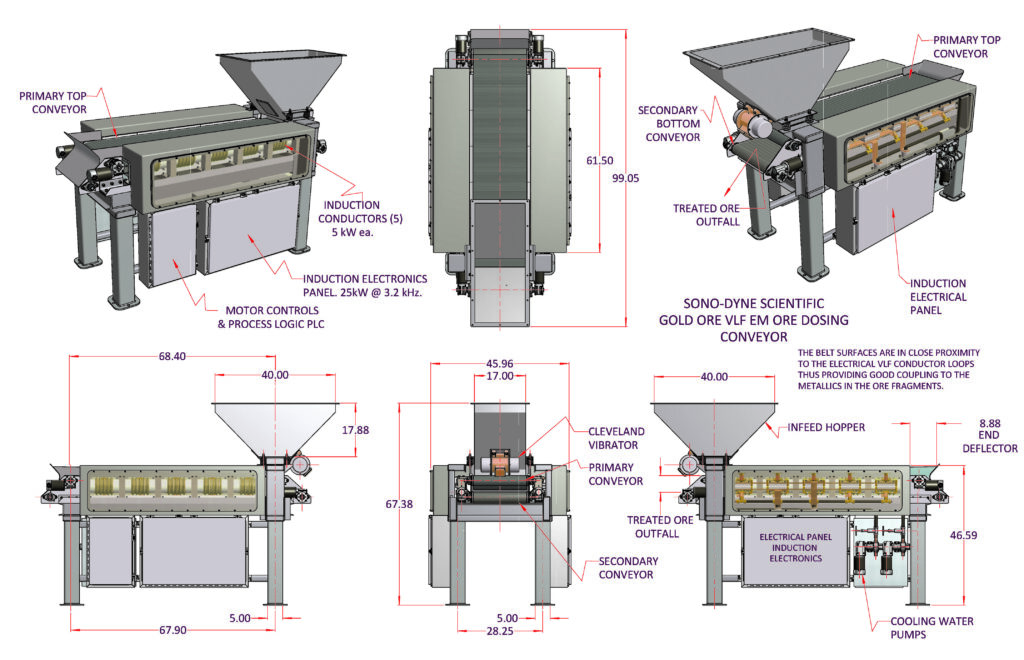
Two counter-rotating conveyor belts, over and under, provide dual exposure of the ore fragments to the EM field generated by a plurality of flat copper loop conductors through which the belts pass.
Induction modules stack together lengthwise and provide pathways for the conveyor belts carrying the gold ore fragments thereupon. The adjacent parts surrounding the flat conductor coils are made from HDPE, they provide sliding low friction abutment surfaces for the conveyor belts and electrical isolation from the copper loop coils.
All published papers on this topic are attached herein;
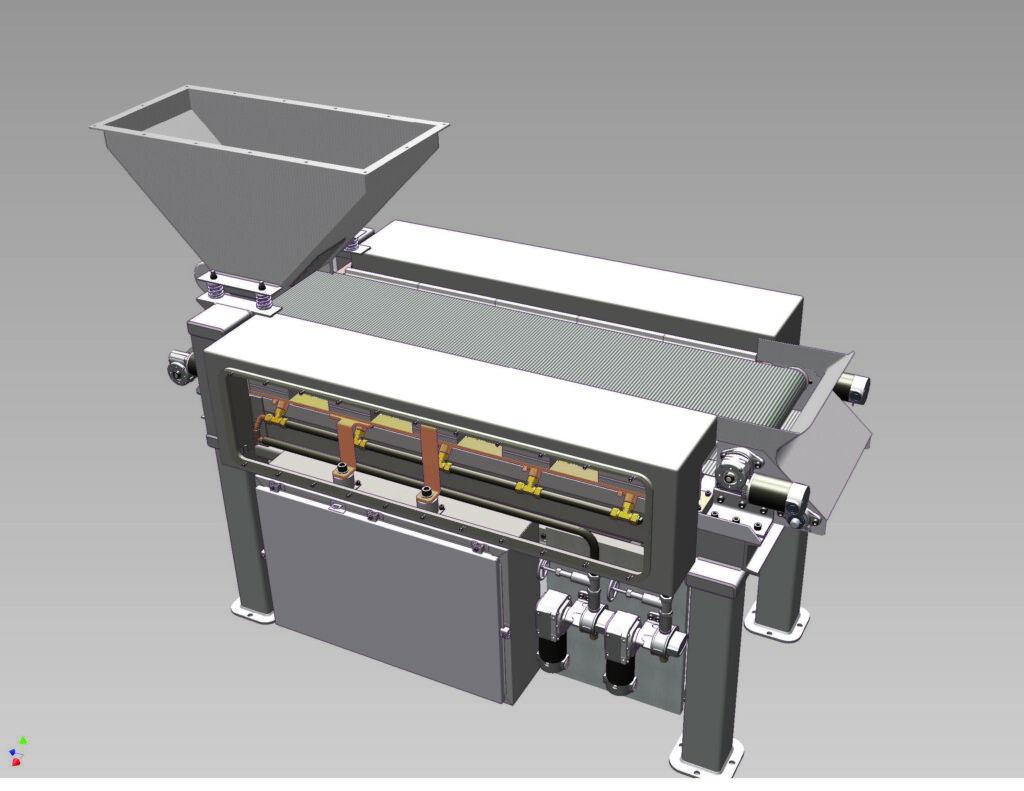
The electronics needed to drive the induction modules is readily available on the commercial market for the EM conductor coils as shown.
Water cooling tubing is silver soldered to the flat copper conductors. This arrangement is easily capable of dissipating 10 kW of power at up to 330 kHz. of frequency,
The conveyor is completely scalable with regards to throughputs and only needs electricity and water.
Barrick Gold Technology Center in Vancouver B.C. Canada. ca. 2009 c/o John Jiang, Chief Metallurgist.
The silver was not allowed to reach an asymptotic flat curve like that of the gold in the assay graphs in the original 13 day bottle roll.
Barrick’s metallurgist John Jiang recommended extending the silver cyanide assay.
Barrick claimed their “Type 2 ore” was depleted and no longer available at their Valedero mine site rendering a completed silver assay moot. The results shown here are highly ambiguous considering their type 1 ore was the subject ore sample in the UTV program not type 2 and silver was the issue, not the gold.
These good original results were overturned by Barrick in a subsequent assay claiming 51 days of bottle roll leaching and in the original published memorandum.
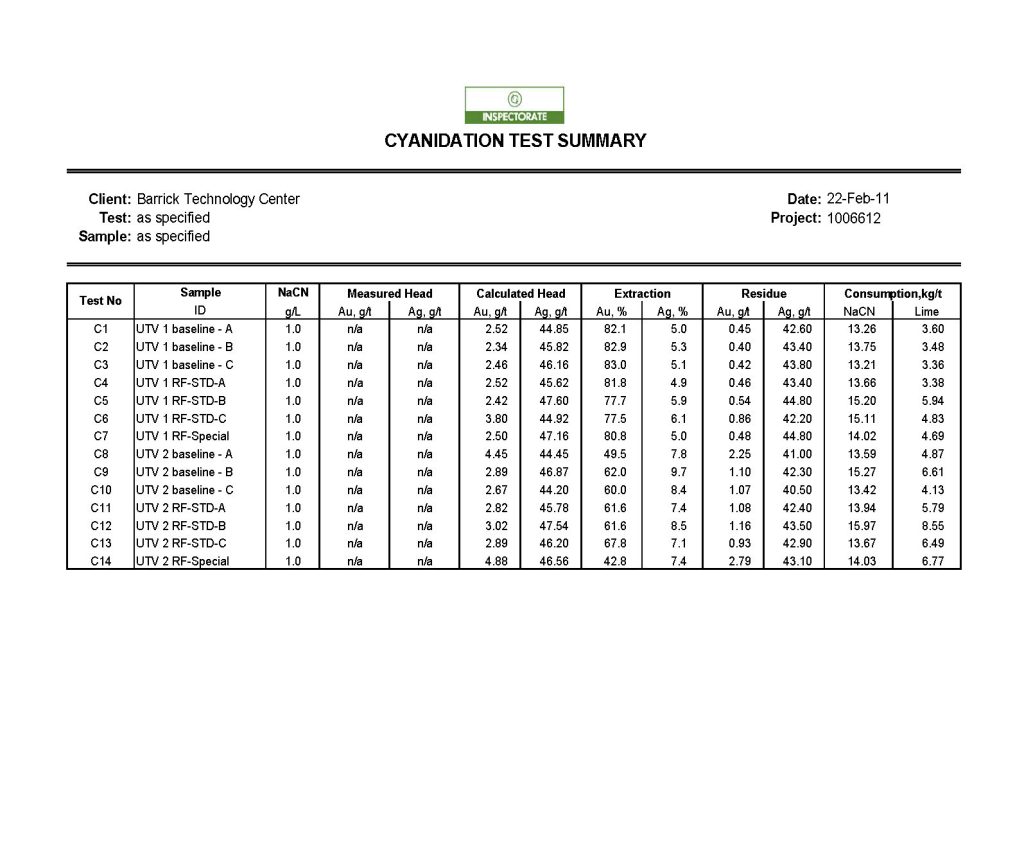
Validation for the required 20% lab proof of silver recovery as per Barrick’s UTV DSA ( Development Services Agreement ) was not achieved, so we commissioned an independent assay lab, Inspectorate in the Delta- Vancouver area that was affiliated with Barrick to repeat the bottle roll assay.
They informed us after 4 days onto the cyanide bottle roll they abandoned it because of “lixiviant chemistry balancing problems”. Here is what we got back from them.
We did not press Inspectorate to repeat the assay and they did not pursue us for non-payment of $5,000. It turned out they were strongly affiliated with Barrick Gold and were biased towards providing us a new silver assay confirming and exceeding Barrick’s original 9% to a possible 20% or more thus forcing the Barrick $10M US payout to us..
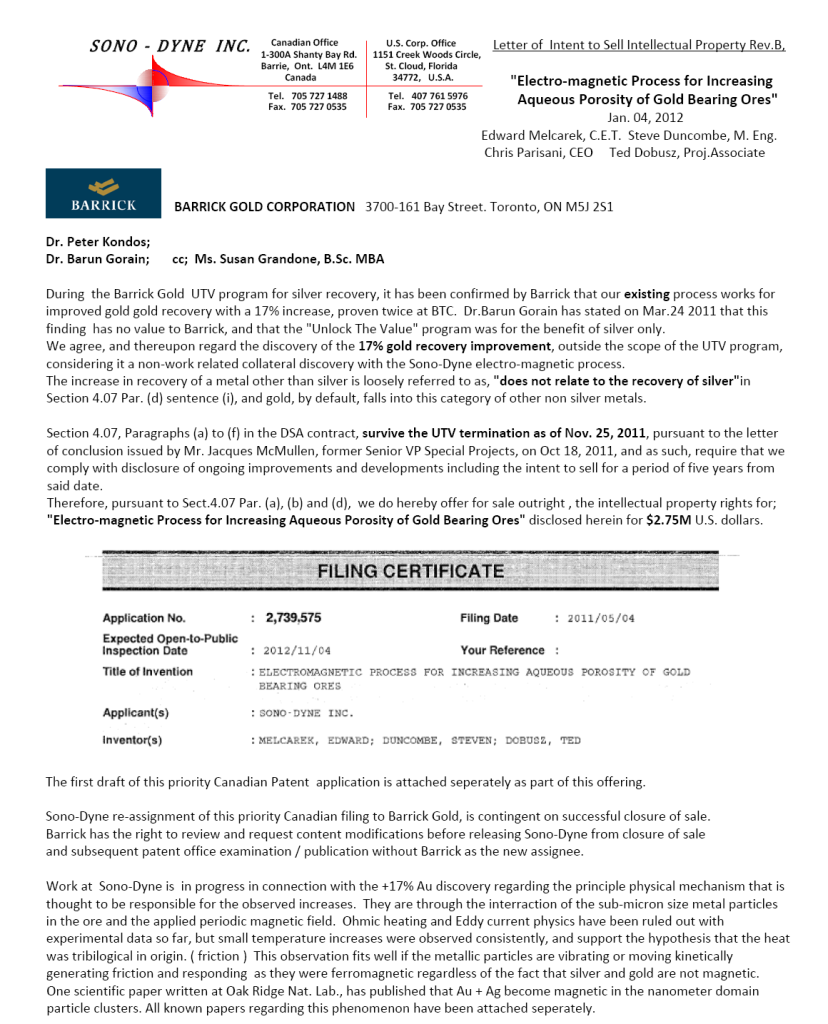
It appears according to Barrick, the physics works for the gold but not the silver.
Validation of 20% silver yield as required in the Barrick DSA contract was not met and subsequently the $10M U.S. award was therefore not paid but the proof of the physics has indeed been proven and validated to be cost effective for the gold instead.


Over and Under counter-rotating conveyor belts bring the ore fragments into the proximal EM field.
.
This novel dual conveyor method increases residence time in the EM field the gold ore encounters as they pass through an arrangement whereby the residence time of the ore in the EM field is twice that of a machine of any length. ( Over and under )
Also there is a new and novel method in the design stages using neodymium permanent magnets as the source of the magnetic field.
All IP rights are reserved to Edward Melcarek and Steven Duncombe c/o Sono-Dyne Scientific.
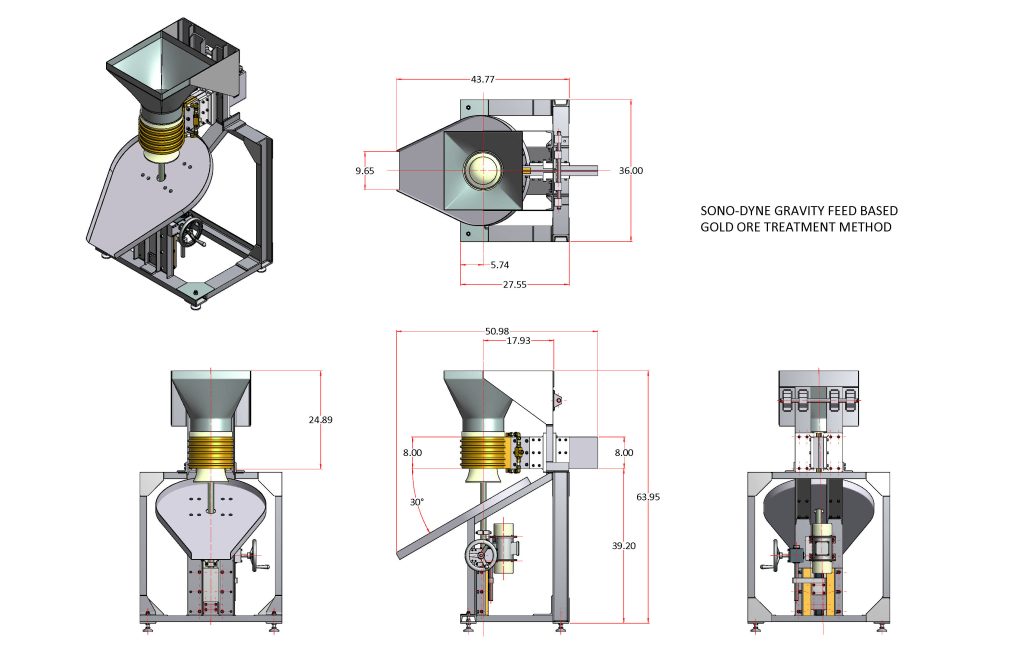
A vertical gravity feed version shown here providing continuous ore fragment passage through the EM field generated by a single high current conductor whereby both magnetic flux density and ore voliume through the exposure aperture are controllable. By Steve Duncombe. US 20160265080 A1